
Du Gia Waterfall looks like the perfect place to cool off on the Ha Giang Loop, but the reality was far busier than I expected. After visiting during my four-day tour, I’m sharing what it’s really like and whether it deserves a place on your itinerary.
I visited Du Gia Waterfall near the end of the first day of my four-day Ha Giang Loop tour. After spending most of the day on the back of a motorbike, cooling off in a waterfall sounded like exactly what I needed.
We knew it was going to be busy before we even reached the water.
Motorbikes were crammed into the small parking area, with a short five-minute walk leading past several shops and a restaurant. Once we arrived, the designated cliff-jumping area had been roped off, leaving surprisingly little room for everyone else to swim or sit in the water.
The quick splash was still refreshing, but the crowds definitely changed the experience.
In this guide, I’ll cover how to get there, swimming and cliff jumping, facilities, costs, crowd levels, and whether Du Gia Waterfall is actually worth visiting.
Du Gia Waterfall in Ha Giang: Is It Worth It?
🚗 How I Book Cheap Transport In Vietnam: Baolau & 12Go Asia
Du Gia Waterfall At A Glance
If you’re in a hurry, here are the most important things to know about visiting Du Gia Waterfall:
| Quick Fact | Du Gia Waterfall Details |
|---|---|
| Location | Thâm Luông village, Du Gia Commune, along the Ha Giang Loop |
| Waterfall height | Approx 6 meters |
| Time needed | 1 hour |
| Entrance fee | Free, pay for parking |
| Walk from parking | Approximately 5 minutes |
| Main activities | Swimming and cliff jumping from several different heights |
| Facilities | Motorbike parking, small shops, a restaurant and a cave bar/dance floor |
| Best for | Cooling off after a long day riding and travelers interested in cliff jumping |
What Is Du Gia Waterfall?
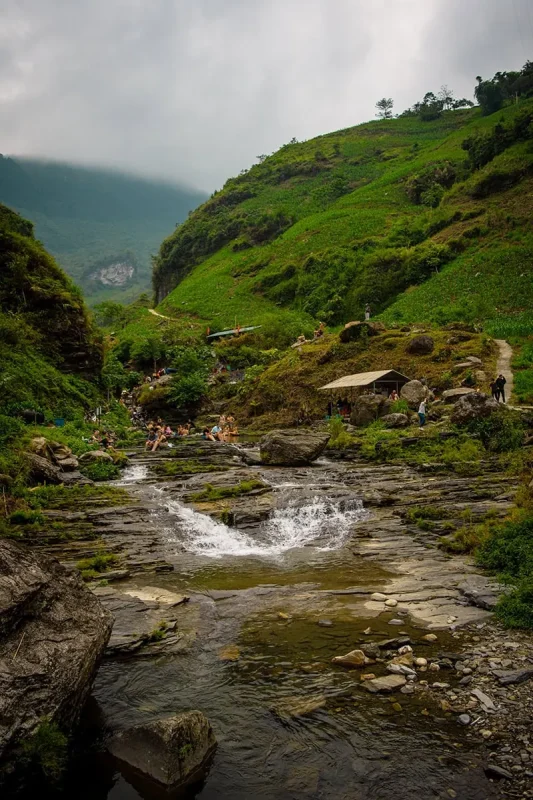
Du Gia Waterfall, locally known as Thâm Luông Waterfall or Ba Tiên Waterfall, is a popular swimming spot just outside Du Gia village in the Ha Giang region.
It isn’t a huge waterfall, but it drops into a natural pool surrounded by rocks and greenery, with several different ledges, perfect for jumping into the water.
You’ll find it on heaps of Ha Giang Loop itineraries because Du Gia is a common place to spend the first night. After sitting on the back of a motorbike for most of the day, stopping for a swim is definitely a welcome way to cool down.
Most people visit to swim, relax in the water, or try one of the cliff jumps. Just don’t arrive expecting a super quiet hidden spot. This was the most crowded of any of the stops I did on the Ha Giang Loop!
How To Get To Du Gia Waterfall
Du Gia Waterfall is easiest to reach by motorbike. If you’re visiting as part of a Ha Giang Loop tour, you won’t need to organize anything! Our Easy Riders took us directly to the parking area.
If you’re doing the loop solo you can search for Thác Du Già on Google Maps. The pin should get you to the correct area, although I’d still download the map offline and double-check the route with your homestay before leaving.
The road becomes narrower and less maintained as you approach the waterfall, so take your time if you’re driving yourself. You’ll definitely know when you’ve arrived, the small parking area was completely packed with motorbikes when we visited.
From the parking area, it only took us around five minutes to walk to the waterfall. The path passes several small shops and a restaurant, so it’s easy enough to follow once you’re there. Oh, and don’t forget the random cave rave.
Before starting the loop, you’ll first need to reach Ha Giang City. My guide to traveling from Hanoi Airport to Ha Giang covers the different bus and transfer options available.

What Is Du Gia Waterfall Really Like?
Du Gia Waterfall is relatively small, with most of the action concentrated around a single natural pool. Between the swimming area, different cliff jumps and slightly unexpected cave bar nearby, there was much more happening here than I’d expected from the photos.
Here’s how everything was set up and what the experience was actually like.
Swimming At Du Gia Waterfall
Calling it a swimming area is probably being generous. Most of the pool was roped off for cliff jumping, leaving everyone else squeezed into a small and very shallow section.
I could sit on the bottom with the water reaching around my waist, but there wasn’t enough room to properly swim.
The water was definitely on the chilly side, even though it was a hot day. It felt refreshing once I was in, but I didn’t stay for particularly long.
We tucked our phones and clothing beside a rock near some members of our group who weren’t swimming.
Nothing happened to our belongings, but I didn’t feel completely comfortable leaving them there because of the number of people around and the fact I couldn’t see them from the water.
I’d definitely bring a waterproof phone pouch or arrange for someone in your group to keep an eye on everything.

🚗 How I Book Cheap Transport In Vietnam: Baolau & 12Go Asia
Cliff Jumping
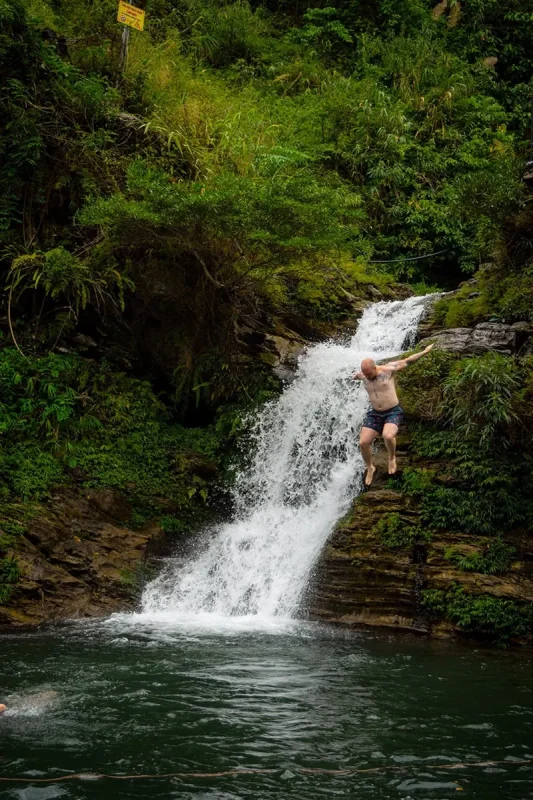
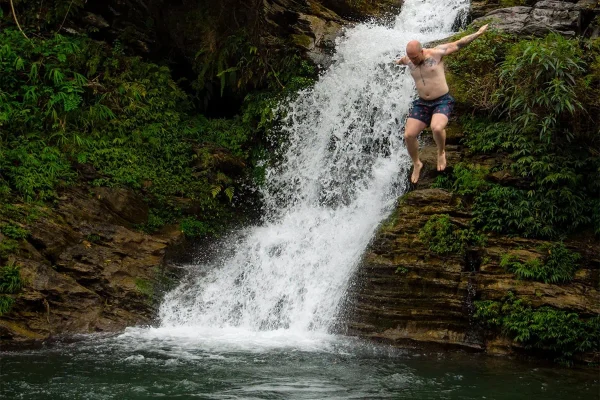
Cliff jumping is definitely the main thing to do here at Du Gia Waterfall. There are several different jumping heights, starting from lower rocks before working all the way up to the very top of the waterfall.
The highest jump looked pretty intense, to be honest. Think two long poles positioned at the top, almost like ski poles, which jumpers used to push themselves forward and away from the rocks.
A local man was also stationed up top, showing people how to do it and making sure the water was clear before the next person jumped.
I was more than happy watching from below and had absolutely no desire to try it myself. Although my partner did give it quite a few goes to my surprise.
How Crowded Does It Get?
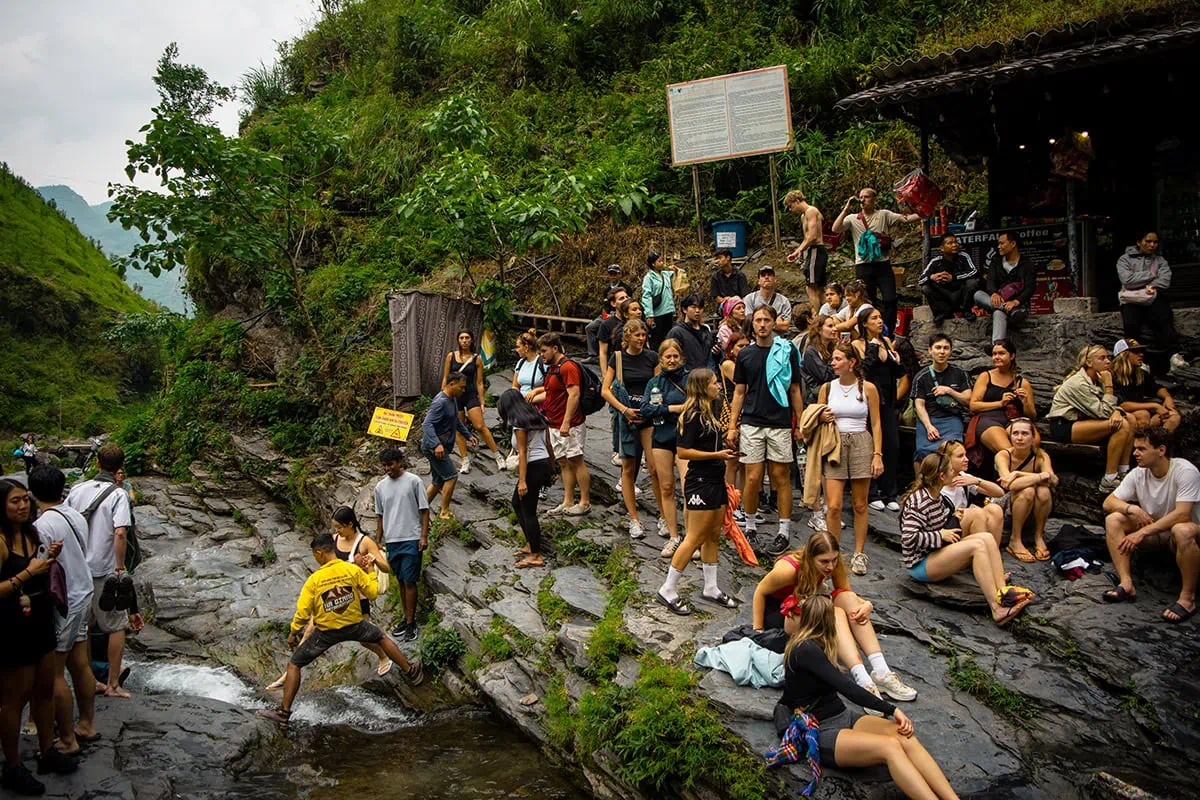
In my experience, Du Gia Waterfall gets extremely crowded. We visited during the late afternoon, which seems to be when many Ha Giang Loop groups arrive before checking into their accommodation in Du Gia.
Several tours were there at the same time, and the atmosphere felt more like a busy group hangout than a quiet waterfall in the mountains.
This didn’t completely ruin the stop, but it definitely made it harder to relax and enjoy the surroundings.
If you’re visiting solo, I’d try to arrive early in the morning before the tour groups begin turning up.
You may still share it with other travelers, but you’ll have a much better chance of finding some space.
Planning Your Visit To Du Gia Waterfall
Du Gia Waterfall is a fairly straightforward stop, but there are still a few things worth knowing before you arrive.
So, let’s get into the facilities, what to bring, safety, and the best time to visit.
Entrance Fee And Opening Hours
Du Gia Waterfall is free to visit, with no formal entrance ticket.
I visited as part of my Road Kings tour and didn’t pay anything separately, although if you’re doing it solo best to carry some cash as you’ll need to pay for motorbike parking.
Google Maps currently lists Du Gia Waterfall as open 24 hours. However, I’d only visit during daylight, and keep in mind that the nearby shops follow their own hours.

Toilets, Changing Rooms And Facilities
Facilities at Du Gia Waterfall are pretty basic, to say the least.
There were several small shops and a restaurant along the path, so you could easily buy food or drinks during your visit. There was also a small shop and dance floor tucked inside a cave, complete with flashing lights, although not much was happening when we arrived in the late afternoon.
The changing room was honestly quite funny. It consisted of a blanket held up by a few bamboo poles right in the middle of the crowds. Despite hundreds of people being around, I didn’t see a single person brave enough to use it.
I also didn’t see any toilets during our visit, though you probably would’ve been able to find one in the restaurant if you were desperate.
I’d recommend wearing your swimwear underneath your clothes and waiting until you reach your accommodation before changing properly.
What To Wear And Bring
You don’t need to bring much for Du Gia Waterfall, but a little preparation will make the visit much easier:
- Wear your swimwear underneath your clothes: The makeshift changing area offered very little privacy, so arriving ready to swim is definitely the better option.
- Quick-drying towel: There wasn’t much dry space beside the water, so something small that can go straight back into your daypack is ideal.
- Sandals or water shoes: The rocks around the waterfall can become slippery, particularly when hundreds of wet feet are moving across them.
- Waterproof phone pouch: This lets you keep your phone with you instead of leaving it somewhere you can’t see.
- Small dry bag: Useful for protecting your clothes, camera and anything else you don’t want getting wet.
- Cash: Bring small notes for parking, drinks or food from the nearby shops.
- As few valuables as possible: There aren’t any lockers or secure storage areas, so only bring what you genuinely need.
Safety And Accessibility
The walk from the motorbike parking area is flat, easy, and takes around five minutes, with no stairs along the way. However, once you reach the waterfall, you’ll need to navigate across uneven rocks to get closer to the water.
There are no handrails around the pool, and the wet rocks can become extremely slippery. Although the walk itself is simple, I wouldn’t recommend Du Gia Waterfall to anyone with limited mobility.
Du Gia is still a natural swimming spot rather than a pool. A visitor drowned here in July 2023, so always follow current signs and local instructions and never assume a jump is safe simply because other people are doing it.

Best Time To Visit
The best time to visit Du Gia Waterfall is early in the morning on a warm, dry day.
If you’re staying overnight in Du Gia and traveling solo and not on a tour, consider visiting before setting off on the next section of the loop rather than waiting until the afternoon tours arrive.
We visited during an insanely hot day in April, and I got pretty damn sunburned. Though, even with this heat the water still felt surprisingly chilly.
I can only imagine how freezing the water would feel during winter, when temperatures in this mountainous part of northern Vietnam drop considerably.
Is Du Gia Waterfall Worth Visiting?
Du Gia Waterfall is worth visiting if you’re already traveling through Du Gia as part of the Ha Giang Loop. It’s free, easy to reach, and a refreshing place to stop for a quick dip. Anyone who loves cliff jumping will probably enjoy it considerably more than I did.
However, my maybe unpopular opinion is that I wouldn’t make a special trip solely to visit the waterfall. The crowds meant it didn’t feel particularly relaxing, and there wasn’t enough space to properly swim and really enjoy yourself.
I’m glad we stopped, but it definitely wasn’t one of the highlights of my Ha Giang Loop. If I returned, I’d go early in the morning and leave as soon as the larger tour groups began arriving.
My favorite swimming spot on the loop ended up being Hang Tham Lin Swim Cave.
If you’re researching other stops along the route, my guide to the Nho Que River boat ride covers another popular activity included on many Ha Giang Loop tours.

🚗 How I Book Cheap Transport In Vietnam: Baolau & 12Go Asia
FAQs About Du Gia Waterfall
Can you visit Du Gia Waterfall without a tour?
Yes, you can visit Du Gia Waterfall independently without joining a Ha Giang Loop tour. The waterfall is easiest to reach by motorbike from Du Gia village.
Is cliff jumping at Du Gia Waterfall safe?
I wouldn’t say cliff jumping at Du Gia Waterfall is completely safe. The area was roped off, and a local supervised the highest jump, but this is still a natural pool where water depth and conditions can change.
Can you visit during the rainy season?
Yes, you can visit Du Gia Waterfall during the rainy season, but keep in mind heavy rain can make the access road and rocks slippery while increasing the water level and the currents. It won’t always be safe at that time of year.
How long do you need at Du Gia Waterfall?
Around 45 minutes to one hour is enough for most people to visit Du Gia Waterfall, including the walk, a quick swim, and some time watching the cliff jumpers. Allow a bit longer if you’re keen on stopping for food and drinks.
Wrap Up: Visiting Du Gia Waterfall
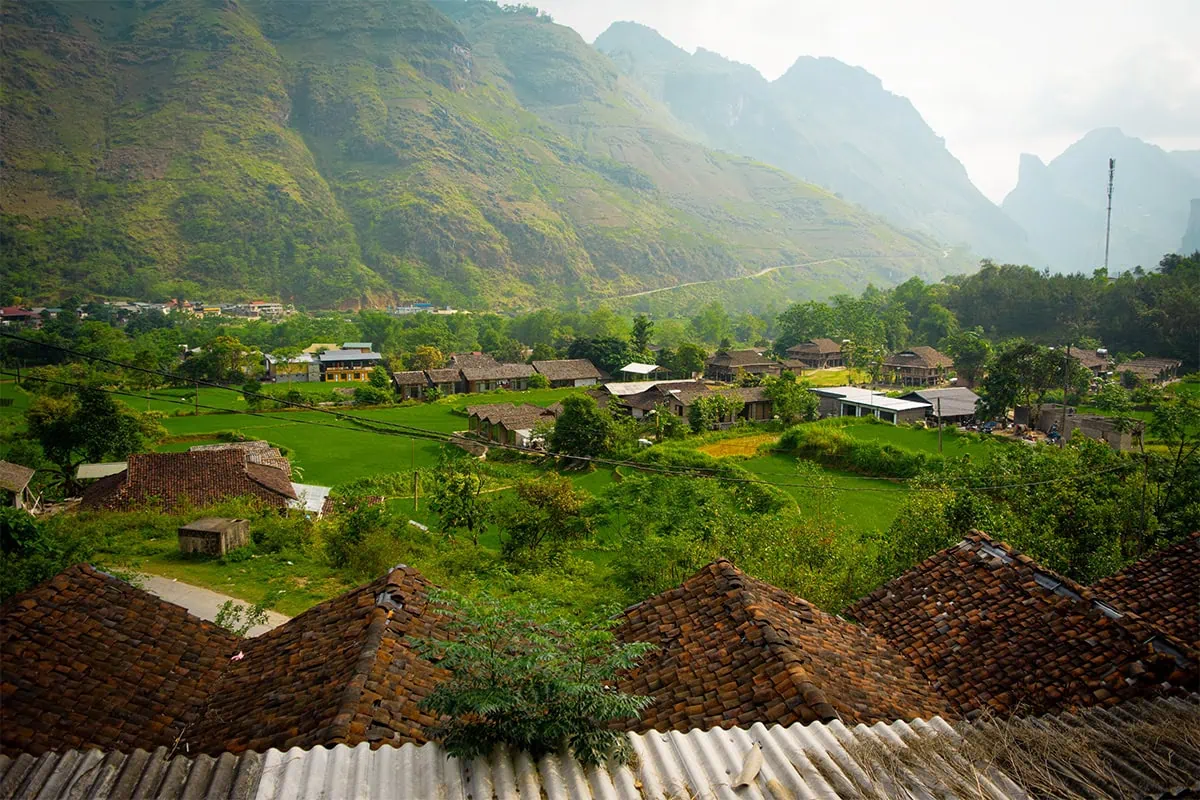
Du Gia Waterfall honestly wasn’t one of my favorite stops on the Ha Giang Loop, but it was a nice way to end the day.
Between the chilly water, people launching themselves from the rocks using poles, the cave dance floor and that questionably private changing room, it felt more chaotic than scenic.
I’d still stop if it was already included in my route, but I’d arrive with realistic expectations. Wear your swimwear underneath your clothes and don’t feel pressured to attempt the cliff jumps.
Ultimately, Du Gia Waterfall is only one small part of an incredible journey through northern Vietnam. You can read my full Ha Giang Loop review for the complete itinerary, costs and everything else you should know before going.
If you’re planning a longer trip through the country, my three-week Vietnam itinerary can also help you plan the rest of your route.
Any Questions? Let Me Know In The Comments!
LIKE IT? PIN IT!

Disclaimer: This post contains affiliate links. So, if you click on it and purchase something, I get a small percentage at no extra cost to you. As always, all opinions are my own, and your support is much appreciated.
Related Posts

How To Travel From Da Nang To Hoi An
Learn how to travel from Da Nang to Hoi An in detail. From the bus, [...]
3 Comments
Staying At Chien Hostel in Hanoi, Vietnam
The Ultimate Hostel in Hanoi’s Old Quarter, Chien Hostel Tucked among the chaotic streets of [...]
38 Comments

Imperial City Of Hue: What You NEED To Know
Find out about spending a day exploring the Imperial City of Hue in Vietnam. Learn [...]
11 Comments

Nha Trang To Mui Ne: Travel By Bus, Train Or Private Transfer
If you are traveling the entirety of Vietnam you will no doubt find yourself needing [...]

Backpacking Vietnam: Travel Guide & Tips For First Time Visitors 2026
Get ready for your backpacking Vietnam adventure by finding out all you need to know [...]

Tra Que Vegetable Village, Hoi An: Is It Worth Visiting?
Find out about visiting Tra Que Vegetable Village located in Hoi An, Vietnam. Learn about [...]
1 Comment
Thanh Ha Pottery Village In Hoi An: Best Tips For Visiting
Keen to explore a quieter spot in the bustling city of Hoi An? Well there [...]
1 Comment

Best Things To Do In Mui Ne: My Top Attractions (2026)
Looking for the best things to do in Mui Ne? From enormous sand dunes and [...]
23 Comments

How To Get From Hanoi To Sapa: Best Transport Options
Want to swap Hanoi’s chaos for rice terraces and mountain views? Here’s exactly how to [...]
2 Comments

Ho Chi Minh City To Phnom Penh: Best Ways To Travel
Traveling from Ho Chi Minh City to Phnom Penh? This guide breaks down the best [...]
3 Comments
Vietnam Sleeper Trains: Routes, Prices & What To Expect
Find out about taking a Vietnam sleeper train. Let’s talk about whether it is worth [...]
15 Comments
Top Things To Do In Hoi An, Vietnam
Hoi An is an absolutely beautiful area and is very popular with locals or tourists [...]
32 Comments
Is Mui Ne Worth Visiting & BEST Mui Ne Itinerary (2026)
Check out my favorite 2 days in Mui Ne itinerary and find out is Mui [...]
10 Comments

Backpacking Ho Chi Minh City (Saigon): My Top Travel Tips
Come check out all you need to know about backpacking Ho Chi Minh City on [...]
1 Comment

Hoi An To Nha Trang: 5 BEST Options Explained
Find out how to travel from Hoi An to Nha Trang while in Vietnam. This [...]
1 Comment
Ha Giang Loop Accommodation: What To Expect From Homestays & Private Rooms
Wondering what Ha Giang Loop accommodation is actually like? After spending 3 nights in homestays [...]

Discovering Lan Ha Bay and Cat Ba Island, Vietnam
Discovering Cat Ong Island and Cat Ba Island in Lan Ha Bay With Ocean Tours [...]
36 Comments
My Honest Ha Giang Loop Review: Is It Worth It?
Thinking about doing the Ha Giang Loop but wondering whether it really lives up to [...]

Hanoi To Hue: Train, Bus & Flight Options Compared
Let me tell you exactly how to travel from Hanoi to Hue in Vietnam. Whether [...]

Hue To Da Nang: The Cheapest & Best Ways To Travel
If you are exploring the length of Vietnam it is likely you will need to [...]
1 Comment
Nho Que River Boat Ride: Visiting While On The Ha Giang Loop
Planning a Nho Que River boat ride while doing the Ha Giang Loop? From the [...]

My Son Sanctuary Hoi An: BEST Tips & Tours (2026)
Come discover the incredible site of My Son Sanctuary from Hoi An. I will let [...]
5 Comments
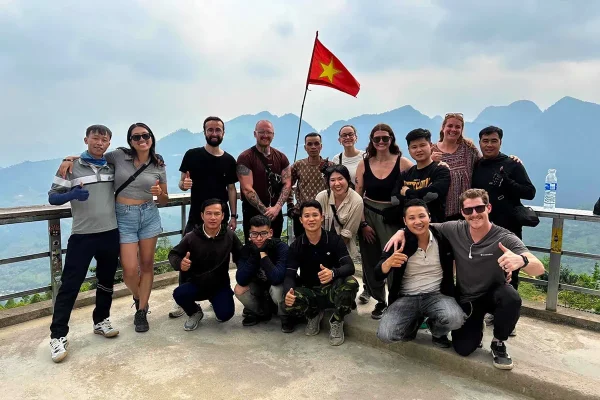
Road Kings Ha Giang Review: My Honest 4-Day Tour Experience
Thinking about booking the Ha Giang Loop with Road Kings but wondering whether it’s worth [...]
2 Comments

Best 8 Beaches In Nha Trang You NEED To Visit!
Come check out crystal clear waters by exploring the best beaches in Nha Trang. Beach [...]

My Vietnam Trip Cost: How Cheap Is Vietnam and My $25 Daily Budget (2026)
Find out exactly how much it will cost to travel Vietnam budget backpacker style and [...]
21 Comments
Hanoi Airport To Ha Giang: How To Get There
Ready to swap the busy streets of Hanoi for the mountains of Ha Giang? Here’s [...]
Best Cu Chi Tunnels Tours: Cheap vs. Expensive Options Compared
Check out all you need to know when it comes to booking a Cu Chi [...]

3 Weeks In Vietnam: My Complete North To South Itinerary
Come find out the best 3 weeks in Vietnam itinerary for the ultimate trip. We’ll [...]
11 Comments
My 3 Days In Hanoi Itinerary For First-Time Visitors
Planning on spending 3 days in Hanoi, but not sure what exactly to do? Come [...]
Sapa In February: All You Need To Know (2026)
Find out what Sapa is like in February and about my experience hiking in pretty [...]
10 Comments
Backpacking Hoi An Itinerary: 3 Days In Hoi An Travel Tips
Come find out all you need to know about backpacking Hoi An to have the [...]

Explore Ha Long Bay On A Budget, Vietnam
Choosing a Ha Long Bay Budget Tour One of the most popular things to do [...]
39 Comments

3 Day Nha Trang Itinerary & BEST Travel Tips
Find out all you need to know about backpacking Nha Trang and my Nha Trang [...]
The Best Things To Do In Vietnam Recommended By REAL Travelers
Find out the best things to do in Vietnam for backpackers and travelers! Listed from [...]
19 Comments
3 Days in Sapa Itinerary: Trekking, Fansipan & a Homestay (2026)
Planning 3 days in Sapa? This mountain town in Northern Vietnam is all about rice [...]
2 Comments

Snorkeling In Nha Trang: Hon Mun Tour Review & Tips
Nha Trang no doubt is a tourist hub in Vietnam, with a lot more of [...]
3 Comments
Backpacking Hanoi On A Budget: My Top Travel Tips
Find out everything you need to know about backpacking Hanoi on a budget while in [...]

The Best Hostels In Hanoi: 9 Top Hostels Worth Booking
Come check out the best hostels in Hanoi for the perfect stay in Vietnam. I [...]
Taking A Vietnam Sleeper Bus: What You Need To Know
Find out all about taking a Vietnam sleeper bus, whether it is worth it, how [...]
7 Comments
Scams In Vietnam: READ BEFORE YOU VISIT (2026)
Come find out everything you need to know about common scams in Vietnam. Be a [...]
4 Comments
My 2 Days In Hue Itinerary: What To Do And Where To Stay
Find out the best 2 days in Hue itinerary to ensure you have the ultimate [...]
Mui Ne To Ho Chi Minh City: Bus, Train, LimoBus Or Taxi?
If you are like me and traveling Vietnam from North to South then you may [...]
Du Gia Waterfall: What It’s Really Like On The Ha Giang Loop
Du Gia Waterfall looks like the perfect place to cool off on the Ha Giang [...]
